Pentagon's DMDC breach: 9 months of hidden access
Unauthorized users read unencrypted Social Security numbers on a Pentagon personnel server for nine months before anyone noticed. What went wrong.
By Yaali. September 26, 2026, 6 min read, Threat intel, Resilience.
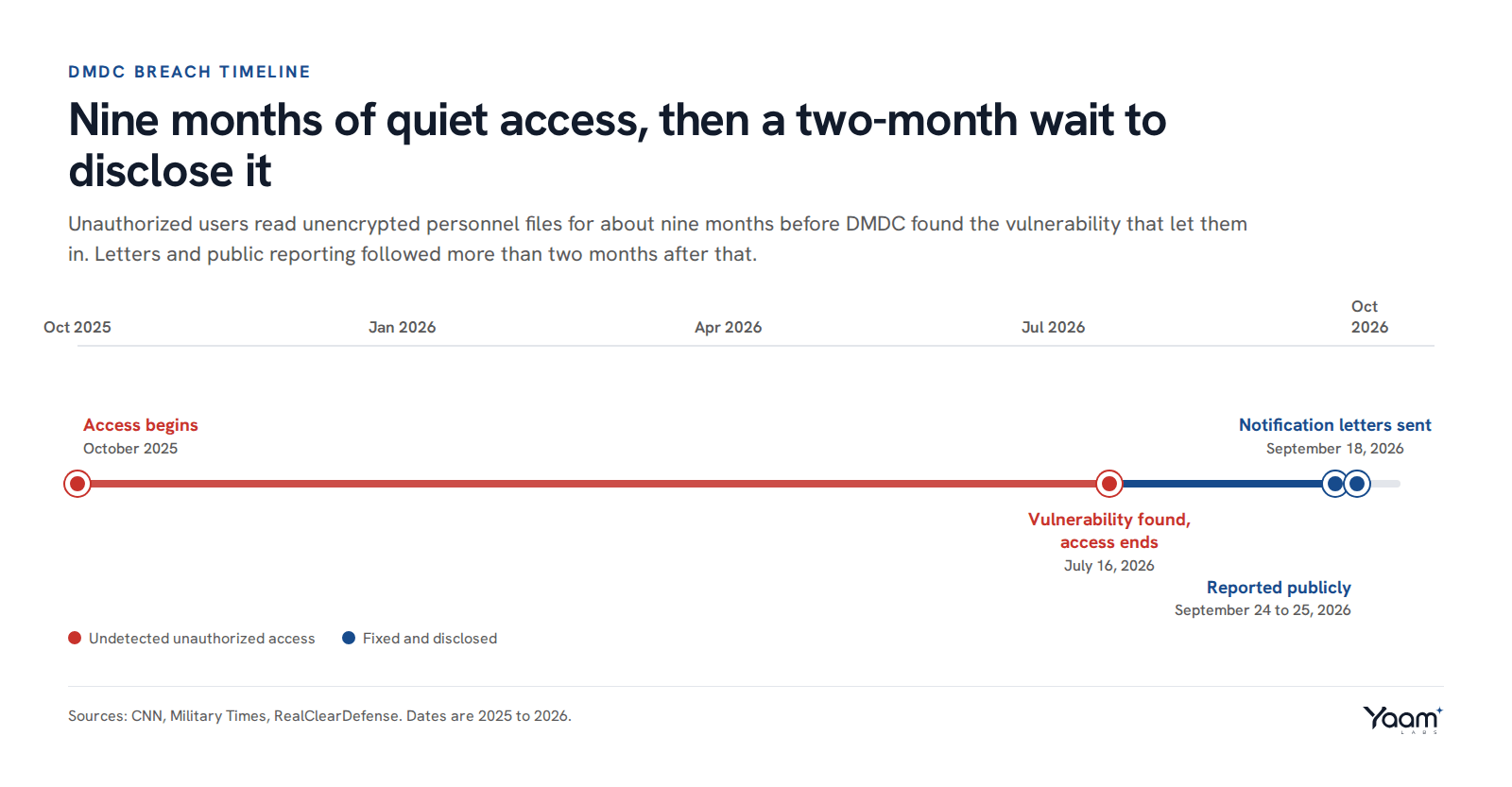
The Pentagon's Defense Manpower Data Center (DMDC), the system of record for current and former US military personnel and their families, has confirmed a data breach that ran undetected for about nine months. Unauthorized users read files on a vulnerable DMDC file-sharing server between October 2025 and July 16, 2026, when the agency found the problem and shut off the access. DMDC started mailing notification letters on September 18, and the breach became public news on September 24 and 25.
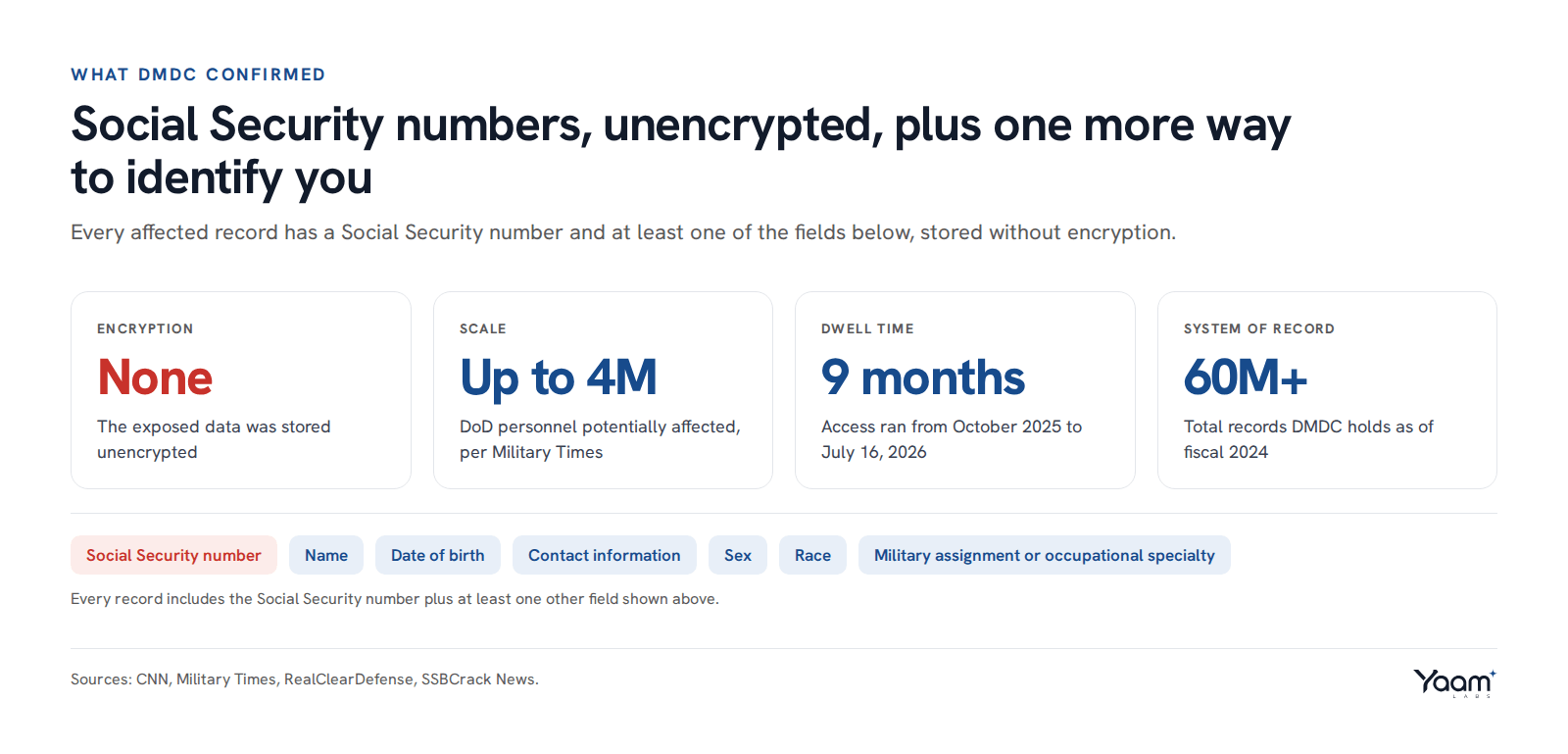
The exposed records held Social Security numbers plus at least one more identifier: name, date of birth, contact information, sex, race, or military assignment details such as occupational specialty. None of it was encrypted. DMDC holds at least 60 million records as of fiscal 2024, and Military Times, citing people familiar with the incident, put the number of Department of Defense personnel who could be affected at up to 4 million. The Pentagon offers a year of credit monitoring and identity restoration through IDX and says it has no evidence yet that the data has been misused. The story here is a detection failure: nine months of unnoticed access to unencrypted personnel data, followed by a two-month gap between finding that out and telling anyone.
How it works
DMDC's file-sharing system is an internal tool built so personnel offices, contractors and record-keeping staff can move documents around without emailing spreadsheets full of Social Security numbers. That is exactly why a compromise of it is hard to catch: someone reading files from a share they already have some reason to touch does not look like an intrusion in a log. It looks like the system doing its job. A firewall or an antivirus tool is tuned to flag malware and blocked connections, not a session that authenticates normally and then reads more files than usual, more often than usual, for months at a stretch.
DMDC says the vulnerability and the unauthorized access were both found on July 16, which means monitoring did not catch the access; a search for the underlying flaw did. That pattern shows up across breaches of internal document systems: the access generates too little noise to trip an alert, so it survives until a scan, an audit or an unrelated investigation finds the hole it came through. Nine months is a long run, but it fits this failure mode, because nothing about the access pattern forces anyone to look sooner.
Encryption changes what that access is worth. If DMDC's stored Social Security numbers had been encrypted at rest, reading the files would have handed the intruder ciphertext, useless without the keys or the application that decrypts it for legitimate use. Storing SSNs and other direct identifiers in the clear turns the file read into the whole breach, with no second step for a defender to catch and no second secret an attacker needs. That is why unencrypted storage is the single biggest amplifier of impact here: it converts access to a file share into a ready-to-use set of identity data.
What attackers are doing
DMDC has not said who accessed the files, and it did not answer press questions about their identity, so there is no confirmed attribution to a specific country or group. What is confirmed is the timeline and scope: access ran from October 2025 to July 16, 2026, DMDC patched the vulnerability and restored the system on discovery, notification letters went out from September 18, and the story broke publicly on September 24 (Military Times) and September 25 (CNN). Up to 4 million DoD personnel are potentially affected out of the more than 60 million records DMDC maintains, though the department says the full scope is still being worked out.
National security reporters and researchers describe this as a counterintelligence problem more than a financial-fraud one. A Social Security number tied to a name and a military occupational specialty or assignment detail works as a ready-made targeting file: combined with other commercially available data, it can help a foreign intelligence service work out who does what for the US military and where, information used to approach, recruit or pressure someone. That risk exists whether or not the data has been resold or misused yet, which is why the Pentagon's "no evidence of misuse so far" only covers what investigators can currently see.
What to do if you run an internal file-sharing or document system
Any organization holding PII in an internal file-sharing, document-management or collaboration system can use this incident to check four specific things.
- Encrypt SSNs and other direct identifiers, at rest and in transit, even on systems you consider internal-only. "Internal" describes where the server sits on the network, not who might eventually reach it. Field-level encryption on the SSN and other high-value columns means a file read alone is not enough to get usable identity data.
- Apply least-privilege access to any share or folder that holds PII, and review it on a schedule, not just when someone changes roles. If every HR or records account can read every personnel file, one compromised account is a full-population breach.
- Log every read of files containing PII, not just writes and deletes. Most file-sharing platforms log access if you turn it on; confirm yours does, and that the logs go somewhere that gets reviewed, not just somewhere they are stored.
- Run periodic access-pattern audits looking specifically for accounts reading an unusually large volume of PII-bearing files over time. That is the exact anomaly that went unnoticed here for nine months: a sustained pattern of reads, spread out enough that no single session ever triggered a threshold. A quarterly review comparing each account's file-read volume against its own baseline catches what a real-time alert tuned for spikes will miss.
What affected personnel and families should do
If you serve or served in the US military, or you are a family member in the DMDC system, your notification letter, if you get one, says whether your record was involved and how to enroll in the free credit monitoring and identity restoration through IDX. Since the department says the full scope is still being confirmed, act even without a letter in hand: place a credit freeze with Equifax, Experian and TransUnion, free and effective until you lift it.
Watch for phishing that uses this breach's specific details as bait: messages about PCS (permanent change of station) orders, TRICARE enrollment, or a request to "verify" your Social Security number to fix a records issue. This data makes those lures far more convincing, since the sender can reference a real assignment history or a real dependent's name.
We help organizations that hold sensitive personal data lock down exactly this kind of internal system through our safeguarding and hardening work, and our security operations team builds the access-pattern monitoring that catches slow, quiet misuse like this before it runs for months. Open the chat and Yaali, our AI agent, will pass your question to the engineer who would do the work.
Sources: CNN, Military Times, RealClearDefense, CommonDef, SSBCrack News.
Read next
- n0n ransomware threatens to destroy your backups
- NightmareStresser seized: how booters work and how to cope
- Astrana Health breach: vishing spoofed its own number
Back to the blog, or tell us about your system in the chat. Yaali, our AI agent, answers first and brings in an engineer.